Different country, different rights: the India lesson for breeders
The right you rely on at home may not exist in your next market, or may come with rules you did not expect. India shows how to read the regime, weigh the risk, and enter anyway.
In short
Variety rights work differently in every country, and some protect very little. India sits outside UPOV, covers only selected crops, and limits the rights it grants. Before you commercialise or trial abroad, research the regime, weigh the risk, and build the partners, contracts and trust that hold where the law is thin.
India is one of the fastest-growing markets in fresh produce, and that is exactly what makes it a test of nerve for anyone holding plant genetics. Take blueberries: domestic demand is forecast to grow around eighteen per cent a year, imports are climbing, and duties on fruit from the main suppliers have been cut to ten per cent. The pull is real, and it is not confined to one crop.
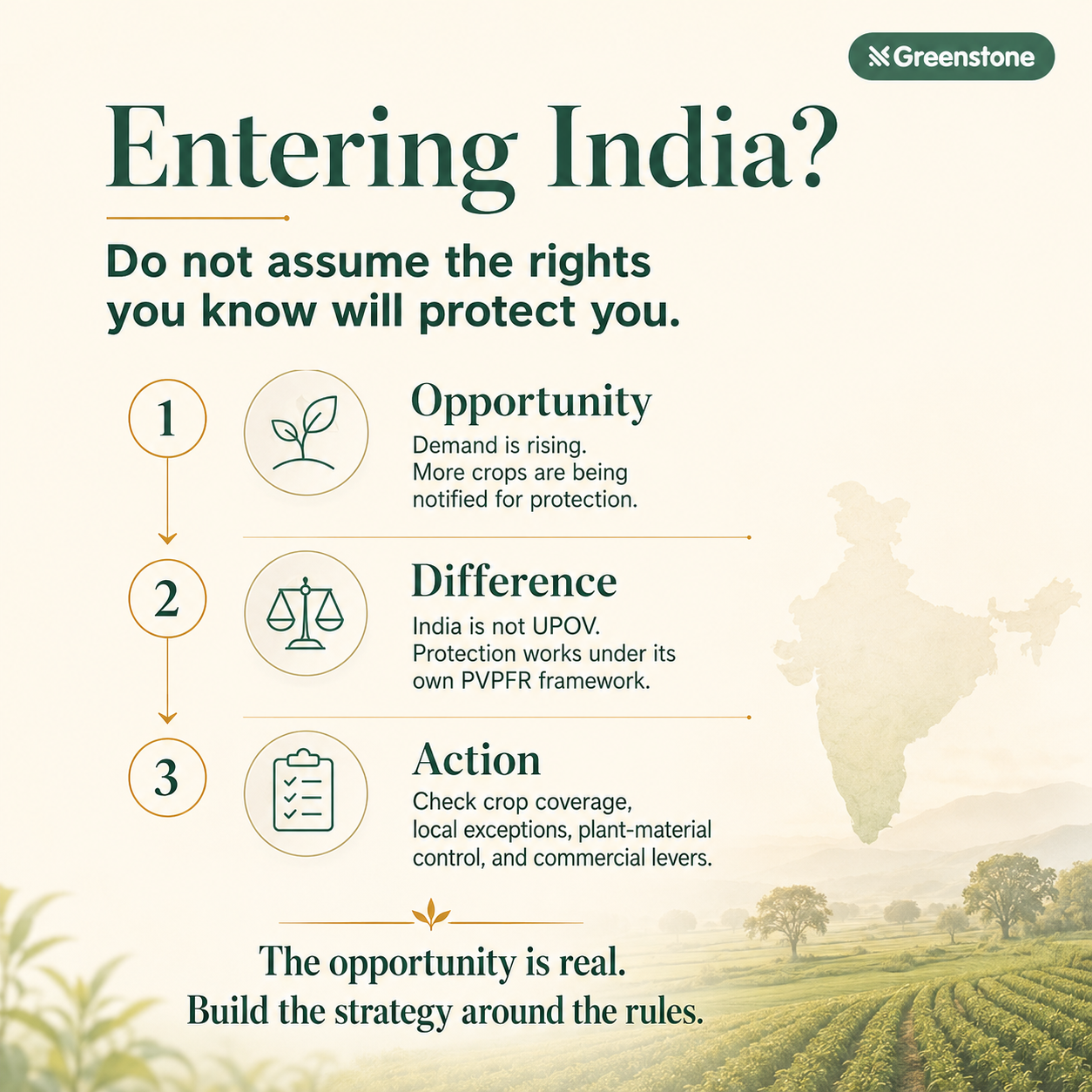
Here is the catch. The plant variety right you rely on at home may work very differently in India, and for many crops it does not exist at all. In May 2026 the government added ten more species to the list it will protect, among them avocado and dragon fruit, taking the notified list to almost two hundred crops. Avocado is now in. Blueberries are not. The rule you take for granted, that a new variety can be registered and then protected, holds only for the crops India has chosen to cover.
Outside UPOV, a different bargain
India is not a member of UPOV, the convention most breeders take for granted, and that is deliberate. UPOV obliges its members to protect every plant genus and species; under the 1991 Act a member cannot pick which crops are eligible and which are not. India wanted to keep something UPOV does not allow, namely broad rights for its farmers, so to meet its trade obligations it wrote its own law instead: the Protection of Plant Varieties and Farmers' Rights Act 2001, run by a dedicated authority in New Delhi.
That law protects new, extant, farmers' and essentially derived varieties, but only for the genera and species the government has formally notified. Before you commit anything, you can check whether your crop is on that list, because the authority publishes it. It also grants a narrower kind of control than a European or American breeder expects, and a few features are worth knowing before you plan around them:
- Strong Farmers' Rights. A farmer may save, use, exchange and even sell the seed of a protected variety, as long as it is not sold under the variety's brand.
- Selective coverage. If your crop has not been notified, there is no variety right to register, whatever its commercial value.
- Benefit-sharing and disclosure. An applicant must declare the origin of the genetic material used, and the system provides for sharing benefits with the communities behind it.
- Compulsory licensing. The right can be opened up by the authority on public-interest grounds.
None of this makes India a bad market to enter. It is simply a different one, and one you have to read before you act.
Opportunity on one side, risk on the other
Put the two halves together and you have the tension every IP holder faces here. On one side, a large market growing fast, the kind of demand that builds a category and rewards an early mover. On the other, a regime that may not protect your crop at all, grants thinner rights where it does, and is harder to police than the one you know. Whether to go in is a commercial judgement, a question of appetite as much as law. The useful news is that the risk is not all-or-nothing, and most of it can be managed.
How to enter without giving the genetics away
When the statute will not do the work for you, the structure has to. In our experience the businesses that enter markets like this well do roughly the same things:
- Research the regime first. Find out whether your crop is notified, what the law grants, and what it withholds, before you ship a plant or sign a grower.
- Weigh the risk against the prize honestly. A fast-growing market can justify entering on thinner protection; only you can price your own appetite.
- Choose partners you can trust, and few of them. Where the law is light, your partner and your contract are the protection.
- Incentivise the people who could undercut you. A licensee who earns well by staying inside the system has little reason to leak material outside it. Make legitimacy the profitable path.
- Write the control in. Set explicit conditions on who may propagate and where the fruit may be sold, keep a right to audit, and use the export-market lever, since fruit grown without authorisation can often be reached when it crosses into a country that does protect the crop.
- Keep your eyes on the chain. Visibility over where material actually moves is much of the thinking behind Argus, the monitoring approach we built at Greenstone. Track the notified-crop list too, because it grows every year.
The thread through all of it is trust built on incentive rather than hope. You are trying to make honesty the easiest and most profitable thing for everyone in the chain to do.
Different country, different rights. Read the bargain before you commit a single plant.
The market is already building the workaround
This is not theoretical; it is already happening. In May 2026 the Italian breeding consortium CIV and the Indian horticulture company Qul Fruits launched a venture called IVAR, billed as South Asia's first dedicated platform for protected fruit variety management and IP stewardship, to bring protected apple, cherry, pear, berry and stonefruit varieties into Kashmir and the wider Himalayan belt.
Look at what it actually does and it reads like the playbook above. The reason given for building it was that "fragmented access to varieties, limited breeder rights protection and unregulated propagation systems" had held the sector back, the same gaps a thin statute leaves open. Rather than wait for the law, they built the missing structure themselves: a committed local partner, structured licensing, end-to-end traceability, and varietal governance. That is research, a trusted partner, solid contracts and visibility, assembled into one vehicle.
You do not need a joint venture to take the point. Strong partners and well-incentivised licensees carry a market like this further than any clause, and the serious entrants put the licensing, the traceability and the governance in place themselves, as the price of entering at all.
Sequence it before the first plant ships
Every one of these decisions belongs before planting, not after: which system applies, whether your crop is notified, what that system grants and withholds, and the commercial structure that covers the rest. Settle them while you still have something to withhold. Once growers are established and the fruit is moving, retrofitting control is expensive and often impossible, because the leverage that would have funded it has already passed downstream.
This is the work we do with breeders and IP holders entering new and unfamiliar jurisdictions: read the regime, weigh the risk, and build the partnerships and contracts that hold where the law is thin. India is simply a clear example of a choice that every fast-growing market eventually puts to an IP holder. Do the homework, and the opportunity is well worth having. Skip it, and you may end up funding everyone's growth but your own.
Frequently asked questions
Does India protect plant varieties?
Yes, but under its own law and only for some crops. India is not a member of UPOV; after joining the international trade rules on intellectual property it enacted the Protection of Plant Varieties and Farmers' Rights Act 2001, run by a dedicated authority in New Delhi. Protection applies crop by crop: a variety must belong to a genus or species the government has formally notified, and that list grows over time. India added ten more species, including avocado and dragon fruit, in May 2026, taking the list to almost two hundred crops. Others, blueberries among them today, are not yet on it.
Why is India not a member of UPOV?
Because UPOV would not let it keep the broad farmers' rights it wanted. Under the UPOV 1991 Act a member must extend protection to all plant genera and species, and may give farmers only a narrow seed-saving exception. India chose instead to build a sui generis system, allowed under the trade rules, that protects breeders while giving farmers a much wider right to save, use, exchange and sell seed. That trade-off is the heart of the difference.
If my crop is notified, is the right like a European or US one?
Similar in that a registered variety gives the breeder exclusive commercial rights, but with real local differences, and the largest is Farmers' Rights. Broadly, an Indian farmer may save, use, exchange and even sell the seed of a protected variety, provided it is not sold under the variety's brand. A licensing model copied from Europe can quietly assume control the Indian system does not grant, so design around the system you are actually in.
What if my crop is not on the notified list yet?
Then there is no registration to rely on for now, and control has to come from the commercial structure: a trusted partner and a solid contract, explicit conditions on propagation and sale, incentives that make legitimacy pay, visibility over where material moves, and the export-market lever. Track the notified-crop list too, because it expands every year and a crop you cannot register this season may be registrable the next.
Book a free 30-minute session
Taking a variety into an unfamiliar market? In a free 30-minute session, we will map which protection applies, what it withholds, and where your control really comes from.
Related topics
More insights
When others want to trial your variety, get it right or everyone loses
A plant variety trial is a step toward commercialisation, not commercialisation itself. Protect the breeder's novelty, and set up the licence the trial could unlock.
Your right reaches the fruit only if the licence lets it
A breeder's right does not automatically reach the harvested fruit. It bites only under specific conditions, and the wording of your licence is what decides whether it does.
How to commercialise a new plant variety: choosing the route that pays
The decision that sets what a new variety earns is how you commercialise it. The main licensing models, the royalty stack, and the sequence that protects the value.

About the author
Tomer Biran, Founder of Greenstone
Tomer Biran is the founder of Greenstone. He has spent more than twenty years on both sides of the table: as a qualified lawyer and former General Counsel to international organisations across multiple jurisdictions, and as a founder and operator of B2B and B2C businesses across the UK, EU, and US. He has served as General Manager of a leading plant breeders' company with a global footprint and as General Counsel of an international fresh produce marketing group. He holds a Master of Law and Business from WHU and Bucerius Law School in Hamburg, where he was a Joachim Herz Excellence Scholar, and a Bachelor of Laws. That blend of commercial operating experience and legal depth is what drives Greenstone's commercial-first approach to plant variety rights and commercialisation.
Connect on LinkedIn